A lot of pain for very little pain

[I make no apologies for the multilingual pun in the title.]

I find bread very disappointing in FF on both historical-immersion and mechanical grounds. Bread, in medieval diet, was the most important food by far. In FF however, bread is a tiny part of the diet that’s only worth making to get extra food diversity for Manors and Mansions - it’s almost as much of a luxury as sweet pastries. Instead, our villagers gorge themselves on vast quantities of milks and cheese, which kills some of the vibe the for me.

I think that it would be better if bread was balanced to be a high-investment high-reward food. It should be relatively hard to setup mass production of bread but, once you have it, it ought to out produce any other farm crop. Would it not be nice if a well developed village was surrounded by grain fields and full of bakeries, with a little meat, cheese, veg and fruit on the side to complement the diet? I think we can accomplish this with small tweaks that improve the weak points of bread making.


Farming
The three grain-producing crops are all kind of weak in the game. Buckwheat has a low yield; and an awkward seasonal, disease and duration combination that makes it really hard to fit into most crop rotations. Wheat and Rye both have a huge negative effect on fertility for yields that are just okay.

One solution would be to give grain crops a much longer growth period (so higher final yield) by having them be an over-winter crop: planted in fall, harvested in spring. That would be a big change to the game however. Simpler would be to massively reduce the time it takes to plant / harvest grain, so that the same number of farmers could manage far larger farms; which historically makes sense. The simplest would be to increase the yield and/or lower their fertility impact.

Mills and Bakeries
All other foods can be eaten straight away, but grain needs to be milled and baked to become edible. That’s nice, it’s the high-investment side of things, but it is lacking on the high-reward side of the equations. Mills and bakeries are pretty expensive, need a lot of workers, and produce food relatively slowly. When all is well, 1 windmill and 1 bakery (so 6 workers in total) can make about 1000 bread per year. By contrast, a single smoker in a much cheaper building can smoke the same amount of meat, and an equal number of preservists can pickle 3 or 4 times as much.

Instead of going 10 grain → 10 flour and 10 flour → 10 bread I think that going 10 grain → 15 flour and 10 flour → 12 bread would be fairer. Doubling the amount of workers a windmill can house might also be justified.

Food Reserves
In the comparison of work time above, the other examples involved making food longer lasting. Bread, of course, works the other way, starting with long lasting food is supposed to be its key advantage. Except that grain doesn’t count towards food storage! You could have 10,000 grain in your granaries, and your villagers would still be unhappy about having only 2 months worth of veg and meat available.

The solution, naturally, is to allow grain and flour to count towards your food reserves despite them not being edible. I made a mod (not yet uploaded) which does just this. To prevent exploiting this by storing lots of grain and never bothering to bake it, I capped the amount of grain/flour that counts as food reserves by the amount of bread consumed in the last year. The justification being that nobody is impressed by your stockpiles of wheat if it never got turned into food!
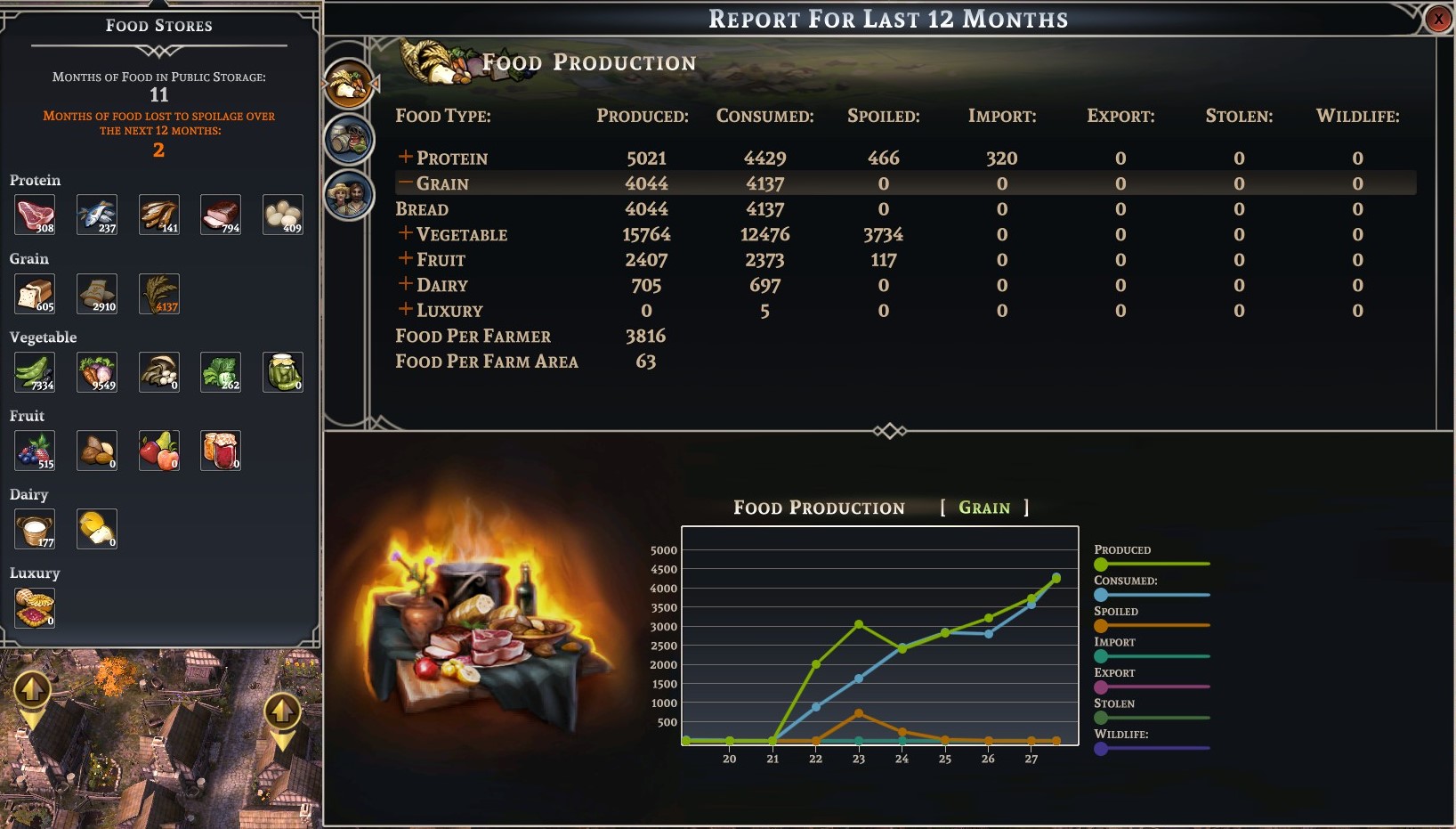
This is a nice boost, but not as game changing as I expected. Because of how hard it is to grow grain, even with this changes having the bread-production-line contribute more than a couple of months of my food reserves is really tricky.

Food Distribution
Even if you make enough bread, the way villagers chose what to eat and what to stock residences / markets with means that it’s pretty hard for bread to get chosen. So a lot of what you make is likely to spoil.

This is part of a broader problem with the logistics of the game IMO, and especially the way it handles individual food vs the broader food types. Not to blow my own trumpet too hard, but Balanced Diet fixes this issue pretty comprehensively for me.


I think that putting all these changes (or even just the last 3) might make mass bread production a feasible, desirable, and rewarding goal for the late game. In fact, there’s a risk that it makes late game food production too easy and upsets the balance of the game. Addressing this increase in late-game food without hurting early game balance might be tricky. Perhaps a 5% appetite increase (as a reverse teeth-of-the-ascetic effect) per house tier for the villagers who live in that house might be about right? It makes sense that more affluent villagers would want to eat more (not just in diversity, but in amount).

That turned out to be more of an essay than I expected. I’m curious if people agree that bread production is rather lacklustre at the moment, and whether that’s actually an issue, and if my proposed changes sound like a good solution. Or have other ideas to contribute to the brainstorm breadstorm.
6 Likes

If this were a French or Quebecois game studio, I’d be more supportive of the pun. However, without the French connection, your pun is toast and the link to bread is lost (Yes, I kneaded more puns in there).
I think the conceit of the game makes bread a harder food to start from scratch because of the historical importance of mills and millers in settled areas. Here, the Settlers are finding areas that are, well, unsettled by others and independent of traditional power structures. Which means resources to make bread will be rare and hard to acquire/build.
I also find that bread is hard to keep stocked in my towns and I often resort to 1 bakery per 500~700 population to keep bread on the shelves. I try to use them for the Desirability effect as well and keep them closer to markets/centers of population.

All that said, I am playing on Idyllic Valley mostly, with settings ranging from normal to hard, so I am not doing the hardest difficulties.

tl;dr: I don’t see the mechanics of bread as problematic and the conceit of “going away from everyone else” handles the breakage between historical bread/flour and in-game bread/flour usage.

1 Like

Remember that while FF uses medieval/colonial themes it’s not set on Earth so doesn’t have its history.

Naturally, the game doesn’t have to follow real history, but “food = bread” is a theme from mediaevalesque history. The game doesn’t need to follow that theme, but nor does it need to digress from it. And following it would both reinforcement the thematic side of the game and deepen the feeling of progression.

I really like that you can’t make bread early on (and even in the middle game it’s not necessary). It’s nice both from a lore perspective and for game progression that you start as a hunter-gatherer, and have to work hard to get vegetable farms and eventually millers and bakeries up and running. This high-investment side of the equation is great, and I wouldn’t want to diminish it by making bread more like other foods. But it would be more engaging if this high-investment also had a high payoff, which is currently sorely lacking.

4 Likes

I think, like the Spread Animals Evenly thread, that the point of Grain/Flour/Bread is that it scales incredibly well. Mid-to-end game buildings are pretty easy to scale up, EFFING BRICKS ASIDE, to make more as needed.

I agree that if it scaled well, it would be absolutely fine.

But does it? Unmodded, you’re doing well if 10% of your food is bread and it’s all being eaten. Even modded I’ve never been able to push it over 20%ish without spoilage going through the roof. And, even if you are eating lots of bread, because of its just-in-time production nature, it barely counts towards the all important months of stored food for keeping happiness, births, and immigrations high. Late game the problem is not the cost of the buildings, but the sheer difficulty in growing grain and the villagers needing to work in them - I don’t see how that scales well?

I’d argue that having tons of carrots / orchards and preserving them scales far better. And ranching animals for cheese scales incredibly well once your herds are large. Getting them large is hard, but feedstock for cattle is easy to make and the cheesemonger is absurdly efficient in every way.

Here’s a more drastic idea along the high-initial-investment-for-great-longterm-scaling vein. Change the mill to be a huge 5x5 expensive building. But give it slots for 10 workers, each of which turns 10 grain → 20 flour in the time it takes present millers to turn 10 → 10. That would make it difficult to start making bread initially, but once you do, the dividends start flowing. Although even this wouldn’t be enough because of points 3 and 4 in the OP.

2 Likes

I think I’ve done 20+% unmodded with only a little spoilage, but (but!) the problem was that my food supply in that situation constantly was constantly something like 5(3), and it was literally impossible to get it to go much over 6 at any time of year because of the just-in-time nature of the production. They didn’t have anything else to eat, often enough, so of course they were eating bread! (I think I also had around 10% spoilage despite that, just due to production control jitter and when other harvests came in and stuff.)

Of course, as you noted in your food variety mod thread, if you produce all the food subcategories (bread, meat, fish, smoked meat, smoked fish, eggs, milk, cheese, fruit, berries, greens, beans, root vegetables, preserves, preserved vegetables, and maybe nuts or mushrooms), then, on average, the random selection by subtype is going to pull bread less than 10% of the time.

Regardless, it does seem to be true that grains are a lot of work for only sort of okay results, especially buckwheat, which seems to be worse per acre than carrots while also being a fussier crop! The lower fertility demand could matter in poor fertility soil, but I didn’t really find myself wanting to grow it on arid highlands, either, because I could just put beans in the same sort of slot as long as I wasn’t trying to feed animals. With that said, wheat on high-fertility fields, especially large ones, is possibly the only crop where I have actually had noticeable challenges getting the crop in before it rots. (Maybe, if I had leeks on similarly large fields, that would show up there, too, but the combination of long grow time and decent food per square per time makes those two hit particularly hard.)

3 Likes

While that’s true, I don’t think it’s a very good point… The problem is that, ultimately this kind of thinking unmoors the game from any kind of realism, leaving the game-world solely depending on game balance, to guide any choices and the player’s sense of ‘what-ought-to-be’.

Now, if the developers were to provide some kind of world-building, it would be another matter.

4 Likes

Excellent point, not just for this topic but generally. Saying “realism=good” would indeed be a bad take and one that, thankfully, video game design largely stopped taking as gospel over a decade ago.

Historically, grain farming (especially wheat) and bread making was viewed as the pinnacle of agriculture for mass food production. The game aligns itself with that historical knowledge by making grain crops demanding and require a lot of investment in buildings and labour to eat. But then FF drops those expectations right at the end by making bread a very poor choice as a core food.

The problem isn’t that its unrealistic per se, it’s the dissonance between the end result and the expectations created by the fusion of historical knowledge and the game mechanics. I guess you could solve this by changing the mechanics to depart from history more drastically and visibly to the player from the start, but that would really feel like a missed opportunity.

3 Likes

Do you know what other plant from this game is a winter crop - planted in fall and harvested late spring - with double the yield? Peas. Winter peas are a thing.

And this makes little sense to me. Cooked grain are a thing. Kasza - grains cooked in either water or milk is a thing eaten to this very day at least in slavic countries (in last 7 days I have eaten roasted buckwheat, millet and wheat). If anything grain should be consumed like any other food source, with bread being a luxury food - as it used to be. Flatbread was far more commonly consumed.

4 Likes

When we ask to grow corn and potatoes, will you say the game is set on the Middle Ages?

No, I just say it uses medieval/colonial themes, but is not set on Earth. It’s a fantasy world.

2 Likes

It depends where and when really. In Western and Mediterranean Europe, from the Iron Age until the Industrial Revolution, making bread was basically the first thing above pure subsistence that people aimed for. Along with preferring wheat (either “true” bread wheat, or emmer, or einkorn, or closely related grains like rye) over easier-to-grow grains like barley or millet. A lack of (cheap) bread was a sign of a famine. There’s a reason the Roman grain dole was about grain rather than turnips; that Marie Antoinette’s apocryphal quip revolved around bread rather than peas or kasza; and that even today “bread basket” means a particularly fertile region.

So, in this broad context, I think the game gets bread half right: more complex than just vegetables and fruits, but not a luxury food like pastries. What it gets wrong, for the reasons listed in the OP, is the amount of investment and work needed to make bread, and how it doesn’t count sufficiently towards food supplies. This is not just irksome for immersive reasons, it’s also simply a balance issue.


I have, like I tend to do, made a mod to try to fix that. The impact on gameplay is fairly large, so I’m beta testing it here for feedback before putting on it Steam. The change log is:

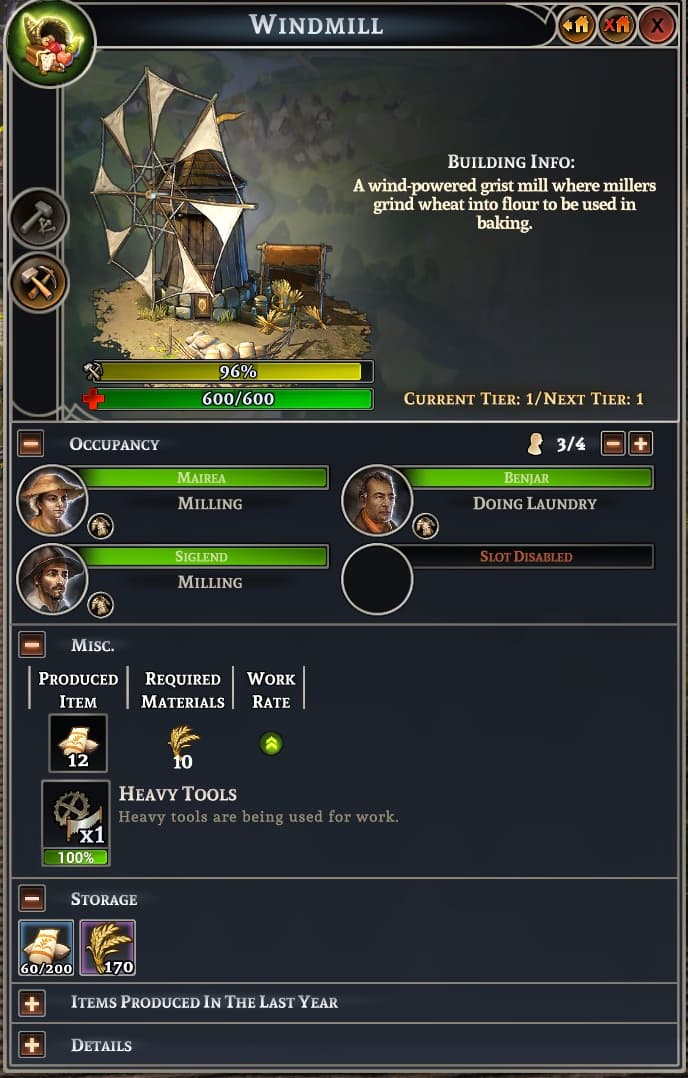
  • Windmills take 10 grain → 12 flour, and have up to 4 millers who work faster than before. The ideal ratio is now about 2 Windmills per 3 Bakeries while before it was 3:1 in the other direction.
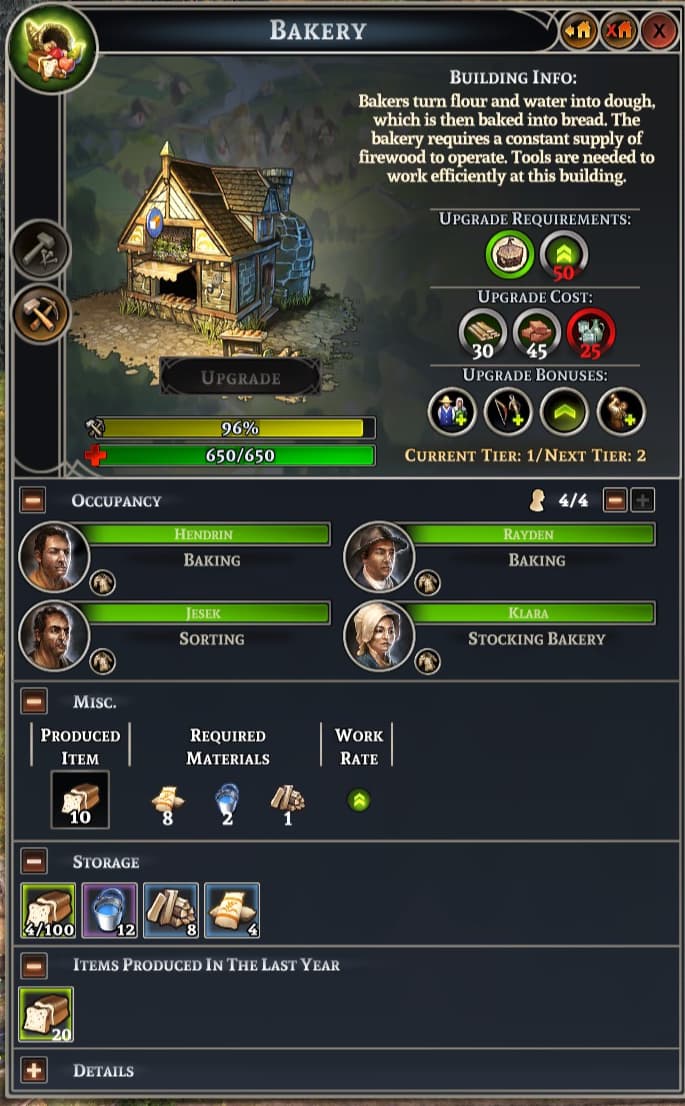
  • Bakeries turn 8 flour → 10 bread. With the above, this means that 2 grains harvested end up as 3 bread.
  • Flour and Grain stockpiles count towards your food reserves - but each is capped at the amount of bread eaten in the last 12 month to prevent exploits (shown in red on the UI when this happens).
  • Villagers get hungrier a little faster as the town develops towards a bread making state. This scales with the average housing tier. Tier 1 is the same as now, tier 2 increases hunger by 5%, tier 3 by 10%, and tier 4 & 5 by 15%. In other words, a fully developed town has an anti Teeth of the Aesthetic relic built in. This should balance out the huge productivity increase in bread making without upsetting early game balance.

I’ve tested this with a few different saves and, as far as I can tell, it all works fine. But I’d like to know if others find bugs or have comments about the balance. Download link is below, unzip the .dll into FF Mono / Mods and see if it appears on Melon Loader to check its loading correctly. I strongly recommend running this with the Balanced Diet mod (available on steam) so all that bread has a chance to get eaten.

Bountiful Bread.zip (5.3 KB)

2 Likes

It’s wild that the base game requires 3 mills to fuel one bakery. Well, I guess I learnt something today as well.

The only reason you don’t notice that it takes twice as long to mill 10 grain to flour as bake 10 flour to bread is that bakeries end up pretty inefficient unless you have a really aggressive system getting that flour close to your bakeries. I’ve seen 25% idleness times with just two bakers before, and 30% with 3 or 4, because they all sit on their hands while one guy goes to fetch another bag of flour. In that 2-baker example, it implies that one of the bakers spends half his time sitting around waiting for flour (or, I suppose, water or firewood).

2 Likes

Yep, it also hurts that bakers only carry a relatively small amount of flour in one go. And, only one can restock flour at once, the others will either restock something else or sit around doing nothing. But because they get through one carry-load flour so much quicker than the other ingredients, the whole thing can lock up. This makes it pretty hard to distinguish “the bottleneck is flour production” with “the bottleneck is flour transportation”.

Incidentally, reducing the amount of flour needed to make the same amount of bread by 20% should alleviate this problem.

But it still almost feels like bug that Windmills have half the staff as bakeries and work at close to half the speed.

2 Likes

It’s absolutely incredible how much more efficient my bakery that is next to the windmill farm is than the others, at least in my most recent town. I’ve tried to mitigate this a bit with storage minimums elsewhere, but I think I may have actually set them too low, even despite that low carrying capacity.

1 Like

City building games are about building cities with efficient layouts for the given mechanics and efficiencies. Smokehouses are more about the product to smoke than the firewood to make smoke. Cluster some hunting cabins next to a Storage Depot set as the only place that stores tallow and park a Soap Maker next to it and watch the efficiency.
That’s the fun, to me.

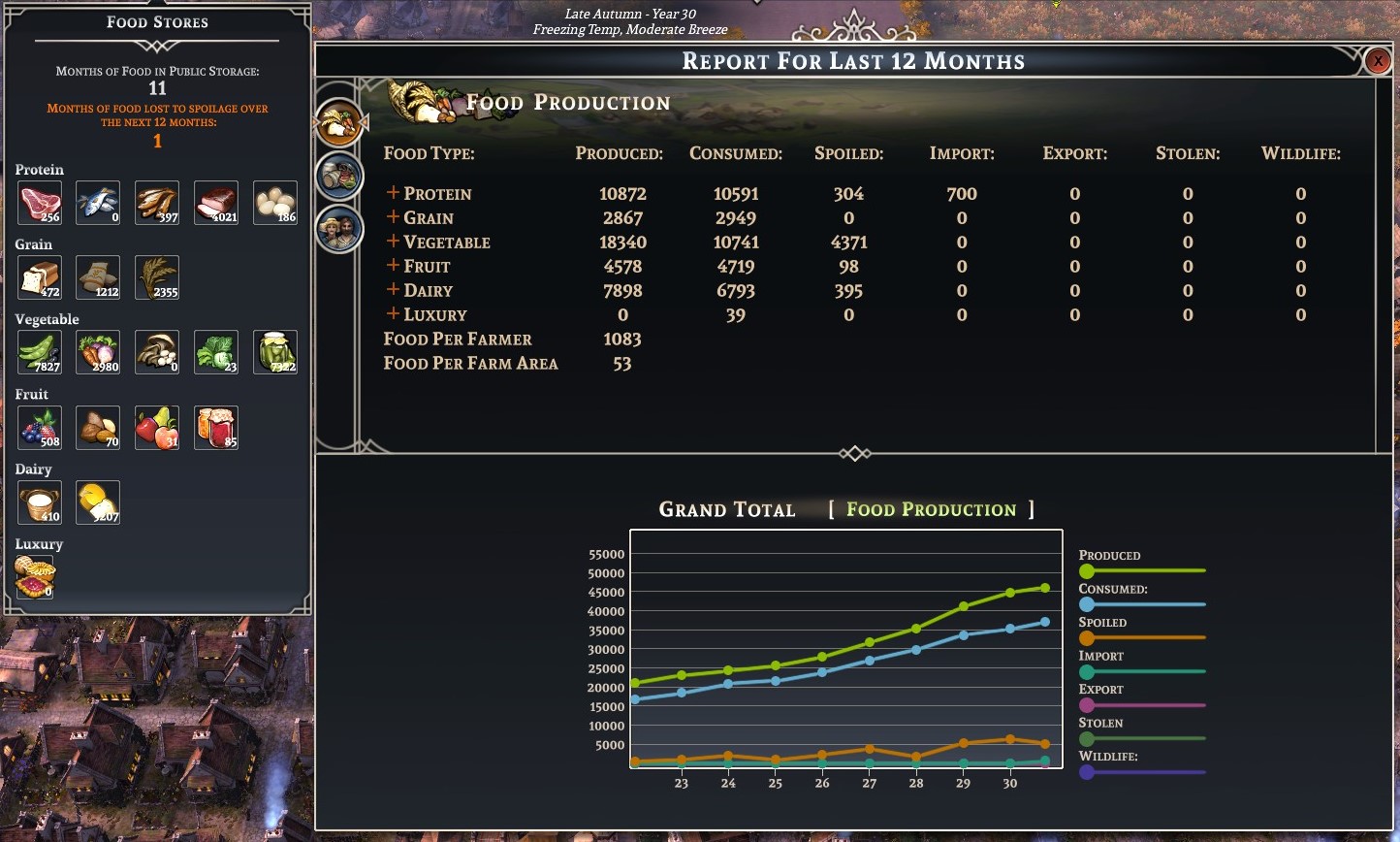
To get back on topic, this is from my current play through with the bread mod above (and Balanced Diet), at 1000 pop, mostly T3 housing but starting the upgrade to T4.

I have 2 mills and 3 bakeries in this screenshot (20 villagers total), which I slowly built up over the last few years. A few things to point out:

  • Bread is my 2nd most consumed food behind veg (meat consumption is doubled counted because of the smoking process).
  • There’s room for me to push bread consumption even higher because none of it is spoiling at the moment.
  • I’m getting an extra 7000 of food stockpiles (about 3.5 months worth) from the flour and grain - I have more grain in storage that’s not counting because it’s capped by current bread consumption.
  • I’m not really feeling the +10%ish food consumption penalty I added from the current housing tier, but that might be because the tech tree makes farming easier (and the “Overseeing” policy is overpowered due to a bug).
  • The blip in Y23 was an experiment with planting leeks and removing all production caps on bread.

One game is not enough data to jump to any conclusions, but it certainly looks like we’re achieving the kind of state I was aiming for! Bread making is viable and worthwhile, but not overwhelming. Again, I’m curious if anyone has downloaded the mod above and what their experience with it is.

2 Likes

To add to the above, I found in the very late game when I wanted food supplies running at 20+ months, bread declined in relative importance. Massive amounts of preserved veg, as well as cheese and smoked meat from ranching, started to dominate. Considering that those are even harder to do than bread at large scale, I think that’s fine for balance.

I’ve uploaded this mod on steam, practically unchanged because I was satisfied with it as it was. But, as always, I’d love to here feedback on whether the changes make the game too easy or too hard.

2 Likes