Logistics in Farthest Frontier

Logistics is of paramount importance in Farthest Frontier. It directly impacts labor efficiency—the very engine that drives material wealth for your settlement.

Imagine this scenario: a blacksmith is at work. He walks for kilometers, spending an entire month traveling to a far corner of the map just to fetch a few lumps of coal. Upon returning to his blacksmith workshop, he finds himself starving, prompting another long-distance journey in search of food. To make matters worse, while back on the job, his toddler reports that their home is out of water. He rushes to the well, and afterwards, heads to the pub for a quick pint of beer. Finally, in a comical twist of irony, winter arrives and he dashes home to warm up—despite being a blacksmith who works in a scorching hot environment all day!

The question is: with such minimal actual working time, how much productivity is left, and how do we solve this issue?

To answer this, we need to know: what does each villager need, what raw materials does each production facility require, and what can storage buildings actually hold?

1. What Villagers Need

  • Food: Whenever they are hungry, they will head to the nearest food storage source (Root Cellar, Market, Temporary Shelter, or even a farm field if the food has been harvested but not yet transported). They can stock up on a maximum of 10 units of food at a time—equivalent to a 5-month food supply.
  • Firewood / Coal: They only need this when winter strikes. When it happens, they will head back to their homes or a Temporary Shelter. However, note that if their home is not fully supplied with firewood/coal by Market workers, they will abandon their tasks to transport it themselves, even if it is just a single piece of wood.
  • Shoes, Hide Coats, Linen Clothes: These are consumable items with useful lifespans of 163 months, 231 months, and 217 months respectively.
  • Tools, Baskets (Exclusive to Farmers and Foragers): Similar to the above, with lifespans of 223 months and 180 months.
  • Luxury & Essential Goods (Depending on housing tiers): Herbs, Furniture, Glassware, Spices, Candles, Soap, Pottery, and Books.
  • Leisure Time: They also need time to drink beer, pray, and seek entertainment.

Solutions for Villager Needs:

  • Build Temporary Shelters near production areas—ideally within a maximum radius of 15 grids—to provide food and warmth during winter.
  • Build a Storehouse / Storage Depot near production zones and set minimum quotas for Shoes, Hide Coats, Linen Clothes, Tools, and Baskets so villagers can be supplied promptly when needed.
  • Entertainment buildings, Shrines/Temples, and Pubs can be placed a bit further away since villagers visit them less frequently, but they shouldn’t be too distant.
  • Construct Storehouses and Stockyards with strict minimum/maximum resource limits, alongside a Firewood Splitter (placed away from residential areas) near the Market. This allows Market workers to restock everything in the shortest time possible.

2. Production Materials and Storage

Every manufactured good requires different raw materials.

Example: To produce tools, you need Iron (stored in the Storehouse) and Coal (stored in the Stockyard). While Coal can be obtained from coal mines or converted from firewood via a Charcoal Kiln, Iron must be processed from Iron Ore and Coal at a Foundry.

It is crucial to note that in Farthest Frontier, some resources are renewable (Logs, Food, Wax, etc.), while others are finite and will eventually deplete, such as Iron Ore, Clay, and Sand. While you can extract these finite resources from Deep Mines, these structures carry high construction costs, yield low extraction efficiency, and require significant transport time and effort.

Therefore, the best way to develop a sustainable, long-term settlement is: instead of trying to exploit distant nodes or Deep Mines, import all raw resources brought by traders at any price (avoid using the “Request” feature as it adds a premium), then process them and sell the finished goods at high valuations (Tools, Platemail Armor, etc.).

Solutions for Supply Chains: Your goal is to centralize entire interconnected production chains into a single hub.

Specifically for the metallurgy industry, you should build the Trading Post at the center of your settlement. Right next to it, set up a continuous cluster containing the Blacksmith Forge, Foundry, Coal Mine, Firewood Splitter, along with a Storehouse and a Stockyard.

Don’t forget to configure the minimum/maximum limits for each material type so that laborers and Wagon Shops can proactively transport them.

The ultimate goal is for the workers of these facilities to only have to walk a few steps to grab all the resources necessary for production.

NOTE: I highly recommend focusing heavily on this industry because it generates high-value commodities. Furthermore, you can boost production speed via the Targo’s Hammer relic in the Temple, combined with the Armaments or Metallurgy bonuses in the Guild Hall.

For the log supply feeding your Firewood Splitters, plant Oak Trees (costing 5 gold but yielding up to 9 logs) nearby. During the winter, unassign all workers from seasonal industries (Farmers, Arborists, etc.) and task them with harvesting logs. Since this involves a massive influx of labor, it also requires building multiple Temporary Shelters nearby.

Following this logic, other production groups should also be placed close together:

  • Footwear & Hide Coat Group: Cows/Goat Barns, Cobbler Shop, and Tannery.
  • Flax Group: Crop Fields, Weaver Building, Paper Mill, Bookbinder, and Guild Hall.

A very well written and thought out post, thank you.
I disagree however with a couple of your points.

  1. Buying raw materials and processing them into finished products to sell is an important aspect for building wealth, but it should be incorporated into a broader blend of income streams.
    -Housing provides a reliable base income regardless of traders supply/demand and does not have variables such as price/cost, item availability or trader frequency. This forms my base income needed for keeping my soldiers paid.
    -Pubs also provide income after tier 3. While their income amount is variable (as is traders) it is not insignificant. You can also control how much beer you produce and how many pubs you build. (beer is one of my best sellers at the trading post)

I use trader income to supplement and advance my gold reserves, not as the primary source.
I use trader resources to supplement my own resource gathering. That way I have enough available at any time. When buildings that require many resources are to be built I buy what extra I need.

  1. Heavy industries have negative effects when placed near the town center. If you build the trading post near the center and then surround it with heavy industry your homes will have a difficult time advancing in tier. The desirability drops significantly the closer houses are to such industries.

I’m not implying ‘my way’ is the best, but I place ‘satellite’ extensions of the main town in each cardinal direction out of town. Each hub is dedicated to specific tasks. One would be for light industry, one for crops and fields, one for livestock, and one for heavy industry. They are far enough from the main town that they do have much of an impact to desirability, but are still within a reasonable distance of the town center and trading post. Wagons are used to transport more distant raw materials to the production/processing locations, which are already located at an intermediary distance.

A stable income stream inherently means a low income stream. In essence, providing essential items keeps your citizens happy, but it also means those goods are supplied at a cheap price point.

For instance, a candle has a base trading value of 10, but it only generates 0.2 gold over a 20-month consumption cycle per household (totaling a mere 4 gold).
For details: Farthest Frontier - Google Sheets

Therefore, overproducing goods to import raw materials, and then exporting those finished high-value products back out, yields far higher revenue and profit margins.

Diversification & Market Efficiency

Production should be highly diversified because each trader has unique demands—some items will be heavily marked up, while others are lowballed. Having a diverse surplus allows you to maximize profits without worrying about being squeezed by a trader’s low offers. That said, as mentioned before, no industry is more lucrative than metallurgy.

Because I optimized this setup, I consistently drain every single piece of gold the traders bring. Combined with a Town Center policy that doubles the gold traders carry (at the cost of slightly lower prices on a few goods), I still average over 50,000 gold per year. This completely blows fixed income out of the water, allowing me to hoard over 3.6 million gold across my vaults and trading posts—even after sinking massive gold and manpower into beating 88 rounds of Taunt Raiders.

Resource Sourcing & Logistics

I don’t deny that a self-sufficient raw material supply is necessary; traders won’t always bring enough, which can bottleneck your production lines. However, this means local extraction should strictly be a minimal safety net to hedge against that risk.

  • Exploiting distant nodes or deep mines drains a massive amount of labor for mining and logistics.
  • It also introduces major inefficiencies, like factory workers walking kilometers just to fetch a single piece of coal or iron ore.

Cutting back on distant mining completely eliminates this logistical nightmare.

Layout Optimization

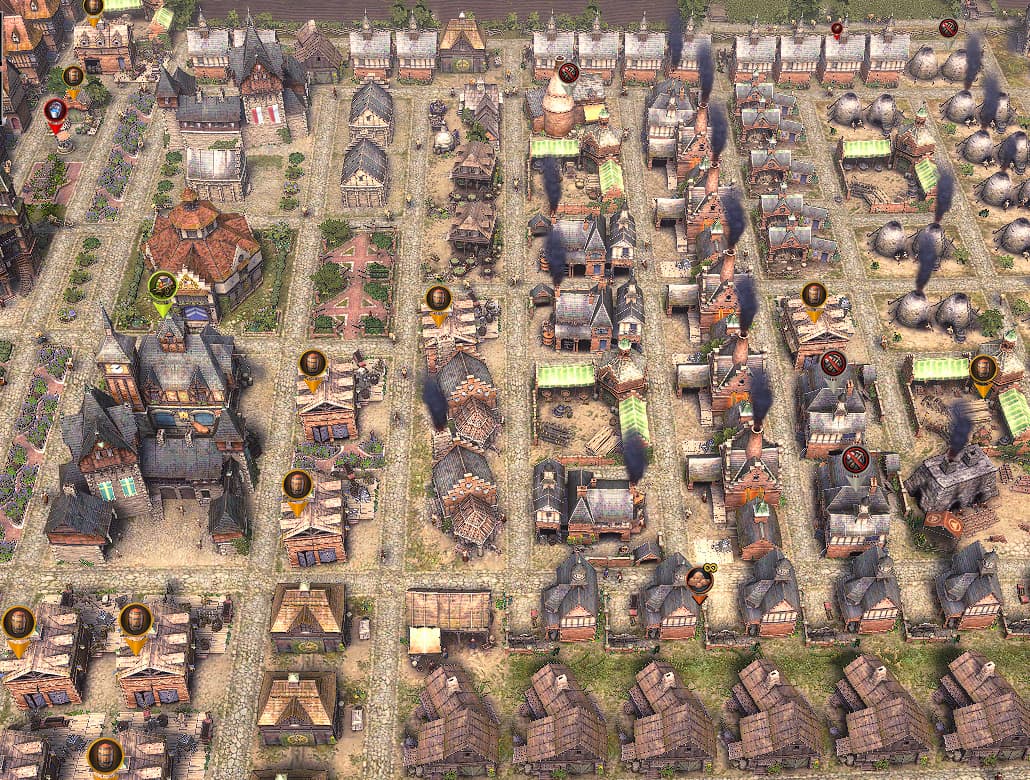
As seen in my attached screenshot, my residential and industrial zones are perfectly separated by the Town Center, trading post, and warehouses. 100% of my houses are Tier 5 (positioned on the left side of the image), and not a single home suffers from negative desirability or pollution impacts.

While your 4-cardinal-direction layout makes sense, you really only need to scatter Temporary Shelters across those production hubs. Your actual residential houses can be tightly centralized in one spot for maximum optimization.

I guess we can agree to disagree.

While your method maximizes gold intake, it does so at the expense of unpredictable external forces. I prefer to have a known monthly income and supplement it with variable income sources.

Temporary housing is essential for more distant locations, but since I use housing as my principal income stream, maximum standard housing is beneficial. Temporary housing does not increase in tier nor does it provide income. It just reduces excessive villager transit and provides safe locations to prevent frostbite. I rely on localized storage, customized storage values and wagons to improve logistics.

It is a tribute to the game design that both of our preferred play styles can be effective.

Housing and pubs alone just doesn’t make enough money for all the gold expenditures, except maybe if you’re playing on the easier difficulties

I agree completely. I use housing income to establish how many soldiers I can support. Because it is a constant baseline that never goes down.
I use pubs and traders to boost my income just like every player. As well as the ‘pots of gold’ scattered around the landscape.
Pubs and traders are variable income. Housing income is not.
My emphasis is just different than the original poster.