Premise:
I understand Grim Dawn II isn’t on the cards for a while, but I’m curious about your thoughts on revamping the Attribute System.
Details:
Right now, attributes mainly affect combat, and have no impact on non-combat situations that involve choice & consequence.
Grim Dawn does have some C&C elements; nothing as extensive as PtD, Shadowrun, Planescape: Torment, or Trudograd, but it’s there. For instance Grim Dawn has, the bandit couple, the near-death dude asking you to kill another dude (the Homestead merchant), or deciding whether to give the supplies to Homestead or the Black Legion.
Non-combat attributes are rare in ARPGs and more commonly found in CRPGs. There do exist games like Dungeon Rats, a combat-focused, turn-based dungeon crawler. Despite it’s core gameplay being combat-focused, that game does include Charisma checks that influence which characters you can recruit, directly affecting the core gameplay. But, since it’s not hack & slash, I guess that example doesn’t work here. The only real H&S example that I can think of isn’t worth mentioning since the final product isn’t great.
Onto the Questions:
What are your (Crate’s) general thoughts about adding non-combat attributes?
Are they something in-line with your general vision for RPGs, or do you think incorporating stat checks for plot situations might negatively affect ARPG gameplay flow?
Non combat stats do not really have a place in an ARPG. It would have to be a cumbersome system on top of the existing attributes so as not to force players to dilute their power, at which point is it really even a meaningful character choice?
As much as people enjoy the rpg and world building elements of Grim Dawn, that is not at the forefront for most players, who are mostly here to delete a lot of monsters and find cool loot, as one would expect from the genre.
Another reason this works in CRPGs is that you are often commanding a party, not an individual, where it is often wise to have a character with strong charisma/non-combat attributes while the rest of the party acts as the brawn when it comes to combat.
That’s actually a good point. I never considered this.
I can see what you mean. Out of all the ARPGs that I have played, the only games with a degree of role-playing elements are Grim Dawn, Sacred: Gold and Svarog’s Dream. All 3 of them achieved the non-combat bits without introducing any non-combat stats. Which is pretty interesting. I do agree with your perspective about non-combat stats potentially diluting the power of players/builds, which feels pretty antithetical to the core of an ARPG.
This was interesting to read. Thanks for taking the time to respond, Z.
And thank you @eisprinzessin for breaking this out into a separate thread.
Heh well, back in the olden days of the before times, the light radius of the player was more limited and impacted how far you could reliably see in dark places like caves. Kilrian’s blinding bolt reduced your light radius by -80%, effectively making you almost unable to see in his arena.
Light Radius was like a bonus to your view distance.
In all seriousness, I actually think that there is DEFINITELY a place for light/vision impairing effects from monsters, exactly as with Kilrian. Having a graphical representation of a blind that causes the fumble/impaired aim is pretty neato and adds a little flavour to aid immersion.
The “counter” stat isn’t actually required but it also seems cool to have, for the same reason in the opposite direction. When you’re holding Skinner’s Torch, surely you want it to feel like it’s a torch! It’s also a very “additional” stat in GD - it (as it exists right now) and is never available as a single stat so it isn’t a dead affix roll, even if the min/maxers won’t ever take Light Bringer’s either. So I can see why it’s still in game. After all, what would be the point of it’s removal?
I wouldn’t mind if the attributes get deleted. I don’t think they add too much to the game tbh.
Maybe super nerds builders will disagree but it’s probably the least interesting aspect. I find it much more fun to combine skills and items etc.
Also
This is very true. I do like that there’s a good story, but I like it even more that it doesn’t get in my way of whacking stuff.
So, first question worth asking, what’s the value added by such things? Is it different dialog? Is it the possibility of opening new quests/content?
On the one hand, it seems to me that gating content behind attribute investment only suffices to divide the likelihood that a given player will ever find that content, so you wind up spending more time making content for less people. However, on the other hand, that does add some replayability in the long-run, especially with multiple such branching paths to take.
Having said that, I’m not sure an attribute system is necessarily the best way of tackling this. It seems kind of…arbitrary? “Oh, you have 228 Physique, but not 230, so you don’t get the uber special quest!”
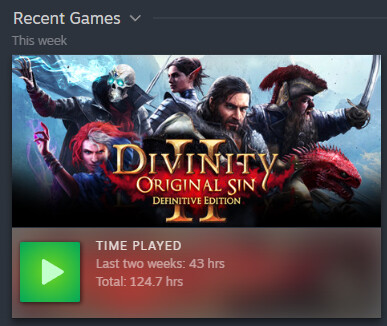
If you’ve played Divinity: Original Sin 2, which I…uh…may be replaying recently…
Divinity uses a ‘tag’ system where members of your party can receive different tags upon meeting certain narrative qualifications/at character creation. Now, there are problems with the implementation of tags in DOS2 as well; e.g., Scholar is the only character-creation one worth a damn. (Something I forgot for my recent playthrough ) But in theory I think the idea of allowing long-ago choices to have far-reaching consequences via such a system makes one’s choices feel more impactful than simply meeting a stat check.
And what’s more, Grim Dawn can already kind of do this - Tokens (which you’d have to pry open the engine/console to see) basically allow for exactly this sort of in-game behavior; however, barring some very select circumstances, most Tokens in Grim Dawn are used immediately after having been received, and at that, only serve a single purpose.
They don’t need to be separate things though, right? I don’t disagree with an attribute check not adding much of a value in an ARPG. But, irrespective of what system you use for C&C, you can always design things in a manner that your choices might not always have an immediate impact but instead have far reaching consequences.
The interesting thing about stat checks is that the consequence doesn’t always have to be the result of a successful check. IIRC, Trudograd has C&C that is influenced by stat check failures.
Also, I’m not familiar with Larian’s IPs, and therefore can’t comment on the “tag system”. I will however say that there’s a legitimate way of implementing C&C that is meaningfully tied to a well thought-out stat system. A couple of the old-school RPGs did it
My main motivation for creating this thread was to see if the role-playing aspect in Grim Dawn could be expanded. C&C is only fun when it’s present in a game where you actually care about what happens with the story. Grim Dawn had that kind of world where I actually cared about how my actions affected the world. But, after reading Z’s perspective, I kind of agree that non-combat stats and by extension stat checks for C&C don’t belong in ARPGs. I mean, you talking your way out of turn-based or RTWP combat is one thing but it doesn’t make sense to talk your way out of combat after creating a character that’s designed to melt God in under a second.
“Ah! Taken! You did it! Thank you for returning the Artifact! Now would you please help us disable the…[Tag_HasItem_SoiledTrousers_Found] uh, you know what nevermind we’ll discuss this, uh…later.”
IMO this is really not needed in GD. All the “choices” in GD are ultimately superficial and you forget about making them 10 minutes later - which is why introducing a system to specifically address these 10 (or something) dialogues in the game doesn’t make any sense. It’s nice that GD has some lore and few dialogue choices with different outcomes but it’s really an afterthought after all.


 but it’s probably the least interesting aspect. I find it much more fun to combine skills and items etc.
 ) But in theory I think the idea of allowing long-ago choices to have far-reaching consequences via such a system makes one’s choices feel more impactful than simply meeting a stat check.