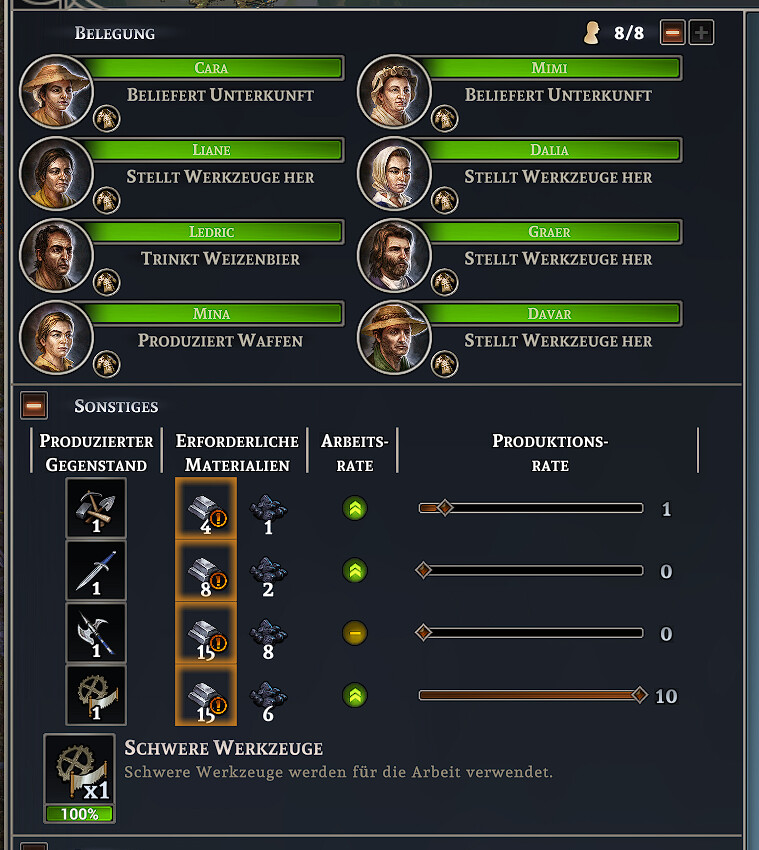
I ran into a major production bottleneck in my settlement that highlights an issue with how production ratios and resource allocation currently work in multi-recipe buildings (e.g., Blacksmith, Smelter, Armory).
The Problem: Low-Cost Recipe Lockout
In my game, my economy came to a complete halt because I ran out of Heavy Tools. After analyzing the issue, I realized I had a temporary iron shortage.
The Blacksmith requires:
Tools: 4 Iron, 1 Coal
Heavy Tools: 15 Iron, 6 Coal
Even though I set my production ratio to heavily favor Heavy Tools (e.g., 10:1 ratio), no Heavy Tools were ever produced .
Why did this happen? Workers do not prioritize or wait according to the configured ratio—they simply craft whatever recipe can be fulfilled with the currently available resources. As soon as a small amount of iron arrived at the building (e.g., 4 units), the workers immediately used it to craft regular Tools because they were also in demand and require far fewer materials. Because the population constantly consumed those tools, the iron pool was constantly drained before it ever reached the 15 units needed for a Heavy Tool.
Currently, production ratios only work properly if resources are abundant. If there is a bottleneck, low-cost recipes completely block high-cost recipes.
Current Workaround (Requires Micromanagement)
The only current workaround is building multiple Blacksmiths and dedicating each building exclusively to a single product (disabling all other recipes). While this works, it forces unnecessary micromanagement and extra space/construction costs early to mid-game.
Instead of defining purely output-based target loops, production ratios should govern resource allocation upon delivery .
Resource Reservation System:
If a ratio is set (e.g., 10 Heavy Tools : 1 Tool), incoming raw materials are partitioned accordingly.
Out of every batch of incoming Iron, resources are held in reserve for Heavy Tools until its requirement (15 Iron) is met, rather than being instantly consumed by the cheaper recipe.
UI & Transparency Improvements:
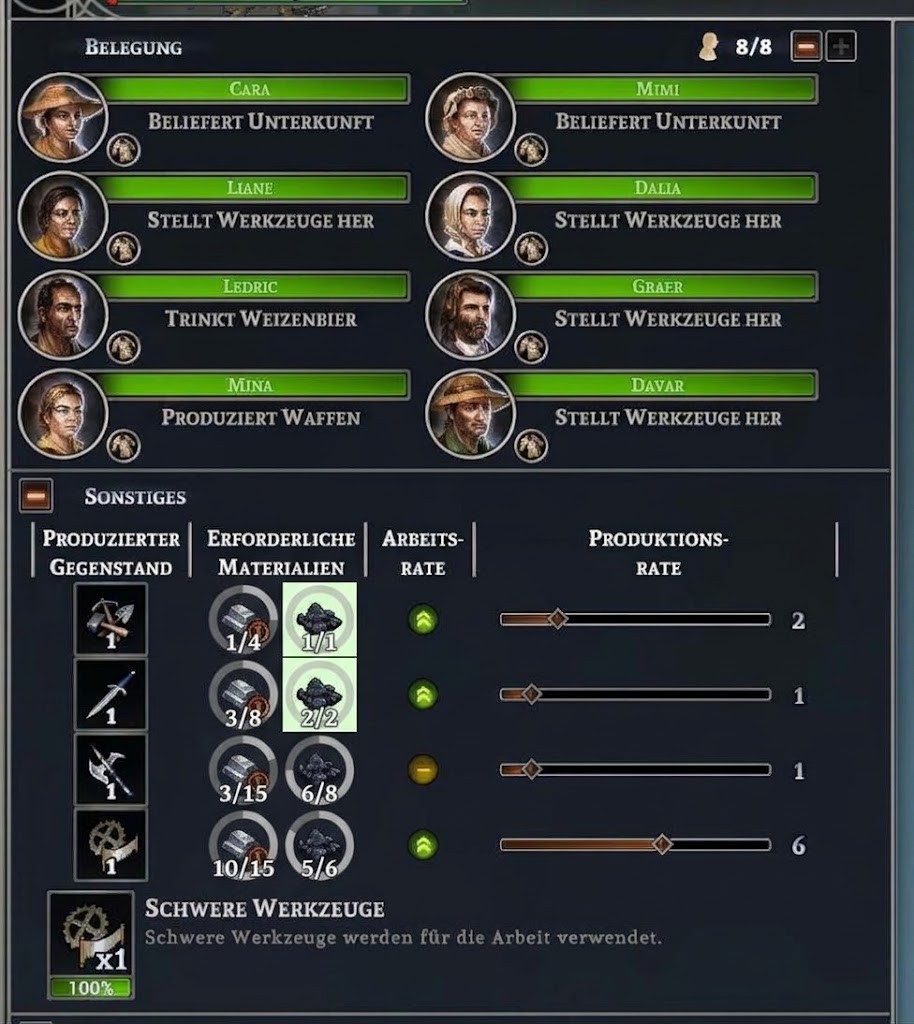
Resource Counter: Display current stored vs. required materials per recipe slot (e.g., 4/15 Iron for Heavy Tools vs. 1/4 Iron for Tools).
Visual Progress Overlay: Add a radial or fill overlay (like a clock/progress bar) behind the icon to show at a glance how close a recipe is to having all materials gathered for the next production cycle.
Benefits
No unexpected production deadlocks: High-cost essential goods won’t be completely starved by cheaper recipes during resource shortages.
Better Transparency: Players can immediately see why a building isn’t producing a specific item and how close it is to starting the next batch.
Applies universally: This logic would improve all multi-recipe buildings across the board without requiring players to spam single-purpose buildings.
Here is a gemini created picture which represents my thoughts. It’s only an Idea!
Production ratios not working well if you’re failing to provide enough resources for the building seems fine really. If your supply drops for whatever reason; you may need to manage the production to account for it. That’s just part of the game.
There are many workarounds that don’t require making additional buildings.
Lower your worker count. You only make 100% tools because you can’t supply enough iron to run the building with that many workers.
Turn building off temporarily to let iron stack up, then turn back on.
Set tool ratio to 0 so you build up enough iron for a heavy tool, then set tool ratio back to it’s previous number after.
Use resource limits to cap production of certain items when they get to a set amount.
Use the trader to buy iron or even just the heavy tool directly for an instant solution.
Setting worker count to an appropriate number and setting resouce limits are core management options that work all throughout the game. The other three are more temporary fixes; but if the iron shortage is temporary then they all work to solve the issue without having to make additional buildings.
Thanks for your input and sharing these workarounds! However, I respectfully disagree with the idea that the current production ratio behavior is fine, as these suggested workarounds don’t address the underlying issue.
Here is why:
Lowering Worker Count Doesn’t Fix the Ratio Problem: Reducing the number of workers simply slows down overall production. Even with fewer workers, as soon as just enough Iron trickles in to craft a standard tool, the artisan will immediately consume it to make that tool. They won’t “wait” to accumulate enough Iron for Heavy Tools just because there are fewer workers—the ratio logic still gets completely bypassed by availability.
Stopping Production / Stockpiling Uncertainty: Pausing the building temporarily to let Iron stack up is a manual micro-management hassle. Furthermore, workers don’t actively stock the workshop with high amounts of raw materials while production is disabled—supplies are brought in as needed for active production.
Resource Limits Don’t Help During Shortages: Capping regular tools via resource limits only works if you already have a healthy stock. If your villagers consume tools faster than you can produce them, your regular tool supply will stay at 0. Therefore, the resource limit threshold is never reached, and the game continues to prioritize standard tools forever.
Intransparency Despite Heavy Imports: Even after buying over 200 Iron from the trader, not a single Heavy Tool was produced in my workshop despite ratios being set. It remains completely opaque why the workshop still prioritizes standard tools over Heavy Tools even when raw materials are abundant.
Conclusion:
Having to manually set a production ratio to 0 or construct multiple separate workshops just to specialize them shouldn’t be the required solution. Ratios exist specifically so players don’t have to micromanage individual recipes or build redundant facilities.
When a player requests a Heavy Tool via the ratio UI, the building should prioritize reserving/saving incoming resources for that higher-tier recipe instead of constantly burning small amounts of raw materials on lower-tier items the moment they arrive.
I’d like to add one more point regarding the suggestion to adjust worker counts:
In my opinion, it is completely illogical that removing workers should be required to satisfy a production ratio or trigger the production of a specific item.
Adding or removing workers is a mechanic meant for scaling overall output up or down based on resource abundance or shortages. Having to remove workers simply because you want to produce more (or any) of a specific resource feels completely unintuitive, contradictory, and opaque.
Production ratios should manage item priorities on their own without requiring players to alter workforce numbers as a workaround.
The solution is very simple: each blacksmith is limited to making one item as soon as possible. This is my progression as I add more blacksmiths:
First blacksmith makes tools and weapons.
Second blacksmith makes heavy tools. I buy 3 from the trader to start with.
Third blacksmith makes heavy tools, first makes tools only, second makes weapons.
Fourth blacksmith makes weapons, second blacksmith switches to tools so now there are 2 on tools.
When I can upgrade to forts, the fifth blacksmith makes heavy weapons.
All products have equal access to the available iron. This method also makes it easy to control how many workers are dedicated to each item. Production ratios don’t seem to work in any building as you would expect, so by limiting a building to a single product the game doesn’t have the chance to choose wrong.
Thanks for sharing your setup! While building multiple specialized blacksmiths is indeed an effective workaround to keep production moving, I don’t agree that it is a solution to the problem—it simply bypasses a feature that isn’t working as intended.
Here is why relying on this method highlights a core game design flaw:
Defeats the Purpose of the Ratio UI: The ratio slider system was implemented specifically so players wouldn’t have to build four or five separate blacksmiths just to produce different items. If the only reliable way to manage output is to force every building onto a single product, then the ratio system is fundamentally broken and redundant.
Unnecessary Space & Resource Cost: Constructing multiple redundant blacksmiths requires extra space, building materials, and monthly upkeep. Forcing players to build additional high-tier facilities just to craft one specific item (like Heavy Tools) because the ratio priority fails under supply shortages isn’t a strategic choice—it’s an artificial tax on city planning.
Inflexible Workforce Management: Ratios are meant to dictate item priority based on current needs, not force players into micro-managing workforce distribution across multiple identical buildings. When a player configures a ratio for a high-tier item, the workshop should reserve incoming raw materials for that recipe instead of burning small amounts on lower-tier items the second they arrive.
Using specialized buildings works as a band-aid, but Crate built the ratio UI to streamline production. Expecting it to function properly without requiring redundant buildings is a completely reasonable feature request!
You should always have extra of a resource stored (in storage buildings) since there can always be random temporary drops in production anywhere in the chain