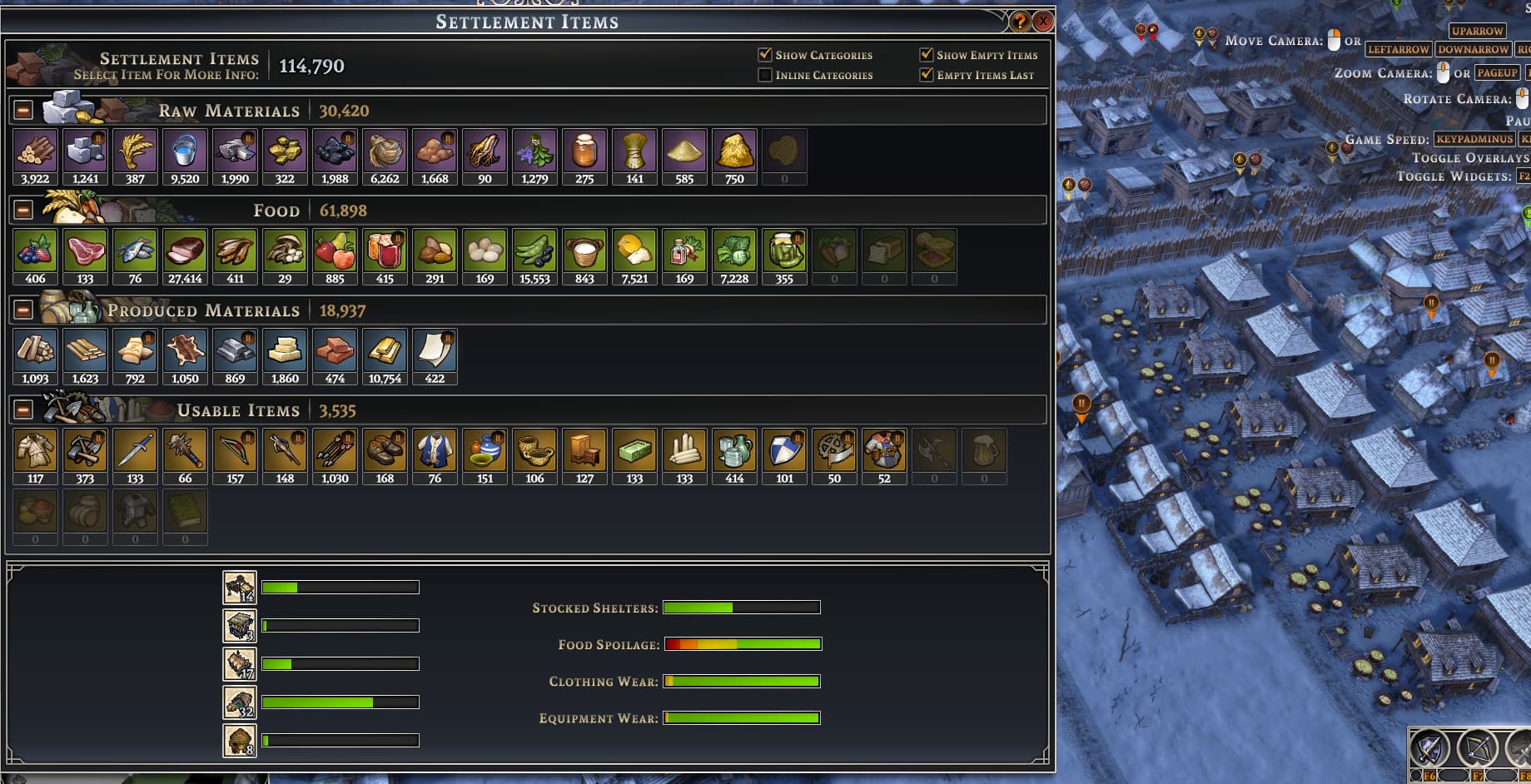
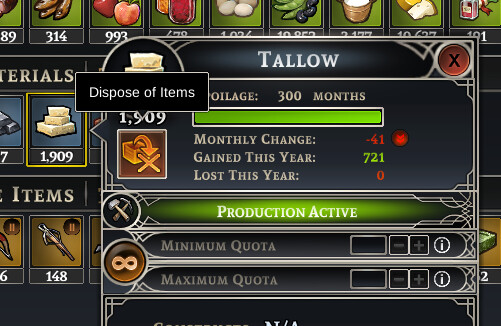
If you impose a cap on the inventory of animal fat and its production exceeds the consumption of soap workshops, when the animal fat reaches the upper limit, butchers will stop slaughtering livestock, resulting in a decrease in livestock health. Therefore, I have some ideas:
Use animal fat as lubricating oil for carriage axles or heavy tools, thereby improving work efficiency while consuming excess animal fat. (May require unlocking new technologies)
The lubricating oil for the axles of carriages can accelerate the carriage’s travel speed, thereby improving transportation efficiency. It is set that each carriage consumes a certain amount of animal fat every month.
For lubricating oil for heavy-duty tools, I believe that heavy-duty tools may be some mechanical devices that require lubricating oil to improve work efficiency and extend their service life. Set a certain amount of animal fat consumption for each heavy-duty tool during its lifecycle.
This is absolutely essential. They just pile up and you can’t sell them; I honestly get rid of them when I have too many because they’re taking up space in the warehouse.
The idea in the OP would be nice especially if it made the wagons move a fraction faster. However, like everything else, it’s still a matter of how you allocate the resources one may have at their disposal.
Whereas an absence of herbs in an established territory may cause a complication, that in itself is only something that can be effectively managed to produce more profitable results. One can purchase herbs from the traders (the “Butcher” trader often has them) as easily as they can sell the soap and sell the herbs back to the trader a much higher mark-up than the original cost.
Not being able to supply those resources from within only requires someone to match production with available resources and consumption. Soap is a serious money maker in my current establishment and any shortage of resources required to make it is only an obstacle to conquer and never a setback.
Merchant inventory / gold doesn’t scale with village size. When you’re small, traders can easily soak up all your excess. But when you start getting large (even just above 1000, let alone 2000+) you can quite easily out produce their capacity to buy. Not just soap, but basically everything.
I build one storage depot that ONLY accepts tallow. This prevents the tallow from taking too much space in a warehouse used for other things. When I get the message they can’t find space to store more, I open the depot and discard all except about 200.
Just a reminder here that in antiquity, tallow candles were overwhelmingly the common choice for everyone but the rich. These were a step up from rush-lights (a broad rush plant bough dipped in tallow or pitch) which were the most inexpensive option of all.
Tallow candles put off a black soot but were cheap, and remained the option for common folks or common occasions. Only when guests were expected might someone put out the clean-burning wax candles, or if you were rich, you would presumably use wax candles all the time.
Tallow candles really should be what we’re using in T1 and T2 towns and the wax candles should be a premium product. This would really help burn up all the excess tallow. Only wax candles should be tradeable at the market. Just my two cents!