1. Combat Realism vs. Game Mechanics in Farthest Frontier
At the end of the day, Farthest Frontier—or any other game for that matter—is still just a game, so it can never truly replicate the actual nature of warfare. In reality, the core strength of cavalry lies in its psychological impact and sheer mobility, rather than acting as the “biological tanks” we often see in video games.
Instead, games usually implement a rock-paper-scissors mechanic to ensure different unit types counter one another. For example, cavalry counters archers, archers counter infantry, and spearmen counter cavalry—typically represented by dealing bonus damage to the countered class.
Farthest Frontier operates on a similar system. However, instead of just dealing extra damage to archers, enemy Heavy Cavalry also possesses an unbelievable immunity to arrows (with an arrow hit chance of only 5%). This feels a bit illogical, as high arrow resistance should technically belong to infantry wielding a Pavise/Scutum, or to Mantlets and Siege Towers.
But then again, FF is a city-builder, not a real-time strategy (RTS) game, so we can’t demand too much. Given that framework, instead of creating entirely new unit types, giving certain existing units high arrow resistance—like Heavy Cavalry or Invader Champions—isn’t completely without merit.
Personally, I don’t find this worth complaining about. The harder it gets, the more fun it is. My only real complaint is that the number of Invader Champions is a bit low; there should be more of them to properly scale up the late-game difficulty.
2. The Broken Victory Notification System
Regarding the victory screen notifications, I completely agree with you. The current setup is heavily outdated and no longer fits the scale of the game, especially for high-population settlements.
Based on my observations, the victory conditions seem to trigger based on the following rough thresholds:
- Flawless Victory: The enemy attacks with > 200 soldiers; you suffer < 10 soldier casualties; zero buildings are destroyed (excluding walls and gates); and absolutely zero civilians are killed.
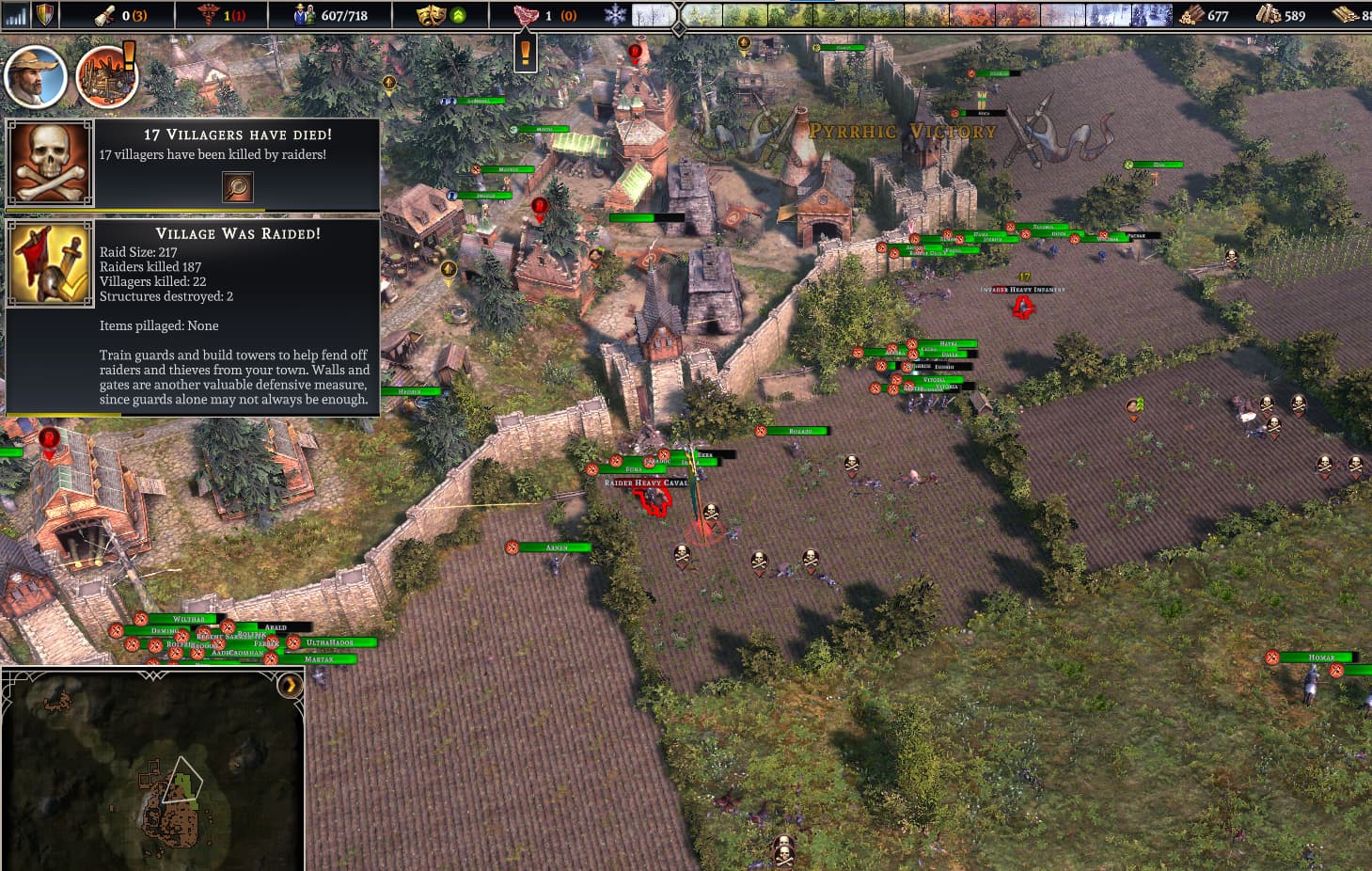
- Pyrrhic Victory: Very few buildings are destroyed, but your soldier casualties exceed 20.
- Defeat Categories: Triggered when the number of destroyed buildings, dead villagers, or fallen soldiers surpasses a certain high threshold.
The core issue here is that the system feels like it was originally balanced for settlements with a maximum population of around 500, so the battle results scale based on that metric. This creates massive logical inconsistencies for mega-cities.
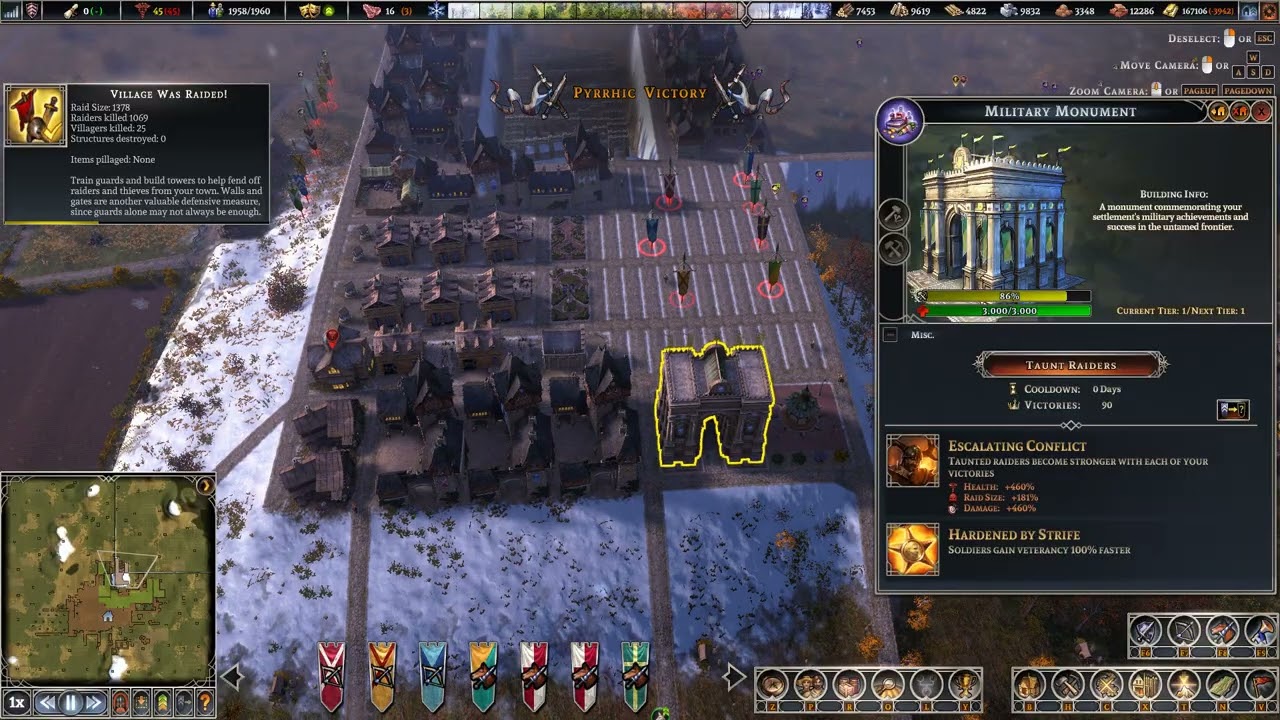
For example: I just defeated Round 90 of Taunt Raider. In this round, the enemies have 5.53x the damage and HP of the strongest raiders in the base game, and their army size is 2.79x larger. My settlement had to fully mobilize 744 soldiers to fend off 1,378 attackers. We slaughtered 1,069 enemies while losing only 25 soldiers, with absolutely zero buildings or villagers lost. Yet, the game still labeled it a Pyrrhic Victory.
If this were a real-life historical battle—even setting aside fighting superhumans with 5.53x HP and damage—achieving a casualty ratio where our losses were just 2.3% of the enemy’s casualties would make any military genius in human history drop to their knees in sheer awe.
Regardless, it’s not something I lose sleep over. I just need the game to register the win. Whether it calls it a Pyrrhic or Flawless victory doesn’t matter to me, as my ultimate milestone is conquering Taunt Raider Round 100.
3. Ark of the Vengeful Dead vs. Taunt Raider Scaling
If I’m guessing correctly, the Ark of the Vengeful Dead relic simply makes enemies more aggressive, causing them to break and retreat much later in the fight. For instance, if an enemy flank normally routs after taking > 80% casualties, activating this relic might push that breaking point to something like 90%. Therefore, this relic doesn’t actually buff the enemy units in a traditional sense (it doesn’t scale their raw damage, HP, or numbers).
The Taunt Raider modifier, however, does the exact opposite. This challenge directly inflates the raw damage, HP, and army size of the raiders. Even at Round 1, these stats see a flat 5% increase across the board. Compounded mathematically ($1.05 \times 1.05 \times 1.05$), enemies in Round 1 of Taunt Raider are already roughly 15.7% stronger than the absolute strongest raiders the vanilla game can throw at you.
Not many players can consistently clear even Round 1 of Taunt Raider. I honestly believe that number represents less than 0.001% of the player base. You should definitely be proud of pulling that off!